Chlorine gets the credit for a clear pool, but it only works when the water around it is balanced. Low pH stings eyes and eats heaters; high pH lets scale form and makes chlorine lazy; low alkalinity sends pH bouncing every time it rains; and without a stabilizer the sun burns off a day’s chlorine by lunchtime. Algae, meanwhile, waits for any of those to slip. This guide covers the chemicals that do those jobs: pH reducers and increasers, alkalinity increasers, cyanuric acid stabilizers and algaecides, which together with a sanitizer make up a complete pool kit. We ranked the balancers and algaecides in our garden catalog by what each one does and how clearly the dosing is stated, the active ingredient, pack size per dollar of treatment, compatibility with saltwater pools, and what thousands of pool owners report after a season or more of use.
We have not run a season of water tests with every product ourselves; the verdicts rest on the published labels and the owner review history. Prices are not printed because they change daily; every button opens the live Amazon page. For the sanitizer half of the kit, see our chlorine tablets and pool shock guide; this page deliberately skips shock and tablets so the two guides do not overlap. For the things you clean rather than dose, our all-purpose cleaners guide covers the deck and furniture.
How we picked
- Owner history. Every pick has hundreds to tens of thousands of owner reviews with strong overall feedback; the Clorox algaecide and clarifier alone has tens of thousands.
- One clear job each. We chose a reducer, an increaser, an alkalinity booster, two stabilizers and three algaecides so a reader can build a complete balancing kit from this page.
- Dosing stated on the label. Picks whose listings give ounces per 5,000 or 10,000 gallons ranked higher, because guessing is how pools go green.
- Saltwater safe. Every balancer and algaecide here is labeled for all pool types, including salt pools.
- No hands-on claims. We summarize labels and owner review history, not our own water tests.
The picks
Clorox Pool&Spa Swimming Pool pH Down, Lowers pH, Protects Against Eye and Skin Irritation, 5LB (Pack of 1)

High pH is the most common problem in an outdoor pool, especially one on salt chlorine, and the Clorox pH Down is the easiest fix. It is sodium bisulfate in dry granule form, poured from a 5-pound bottle with a wide mouth, so there is no muriatic acid to splash, store or fume. Lowering pH into the 7.2 to 7.6 range stops eye and skin irritation, keeps chlorine working efficiently and protects heaters and salt cells from scale. Owner feedback is excellent across thousands of reviews, and the Clorox Pool App turns a test strip into a dose in ounces. The trade-offs are inherent to the chemistry: granules take longer than liquid acid to show on a test, and any pH reducer also knocks down total alkalinity, so test again an hour later and be ready with the Pool Mate Alkalinity Increaser below. A large pool will go through several bottles a year.
- Dry granules are far safer to store and pour than muriatic acid
- Protects equipment from scale and corrosion by holding pH in range
- Excellent owner feedback across thousands of reviews
- Free Clorox Pool App gives dosage from a test strip reading
- Slower to act than liquid acid
- Also lowers total alkalinity, so retest after use
- Five pounds does not last a season on a large pool

Low pH is less common than high in a chlorine pool but just as damaging, etching plaster, corroding metal and making the water harsh on skin. Pool Mate pH Up is straightforward sodium carbonate, also called soda ash, in a 10-pound tub, and it lifts pH quickly when added according to the chart on the label: pre-dissolve in a plastic pail, pour slowly around the pool edge with the circulation running, wait an hour, retest, repeat if needed. Owners give it excellent feedback across thousands of reviews and like that the tub lasts; ten pounds covers a season of small corrections on a typical backyard pool. Soda ash also nudges total alkalinity upward, so if alkalinity is already high use smaller doses, and adding it too fast can cloud the water for a few hours until the filter clears it. It does not come with an app or fancy label, which is part of why it costs what it does.
- Plain sodium carbonate, the same chemical pool stores sell at a markup
- Ten pounds lasts a season for most backyard pools
- Prevents the etching of plaster and corrosion that low pH causes
- Clear instructions: dissolve, pour, run the pump, retest
- Raises alkalinity a little too, so watch that number
- Can cloud the water briefly if added too fast
- Basic packaging with no dosing app
Pool Mate 10-Pounds Premium Alkalinity Increaser for Swimming Pools

If your pH refuses to stay where you put it, the problem is almost always low total alkalinity, and this is the fix. Pool Mate Alkalinity Increaser is sodium bicarbonate, chemically the same as baking soda, packaged with a pool dosing chart: 11 ounces raises alkalinity by 10 ppm in 5,000 gallons, with a target range of 60 to 120 ppm. Holding alkalinity there buffers the water so pH drifts slowly instead of bouncing after every rain or shock, which in turn makes chlorine more effective and prevents the corrosion and plaster etching that come with acidic swings. It dissolves fast and owner feedback is excellent, though the review base is in the hundreds rather than the thousands behind the pH products. Expect pH to creep up a little when you add it, so balance alkalinity first and adjust pH afterward, and know that a pool with very low alkalinity can use most of a 10-pound tub in one correction.
- Stops pH bounce, the root cause of most balancing headaches
- Dosing printed plainly: 11 oz per 10 ppm per 5,000 gallons
- Prevents corrosion, plaster etching and scale
- Dissolves quickly
- Fewer reviews than the other Pool Mate products
- Raises pH slightly as a side effect
- Ten pounds goes fast on a pool that needs a big correction

Cyanuric acid is the most misunderstood chemical in a pool store and the one that saves the most money. Sunlight destroys unprotected chlorine within hours; a stabilizer level of 40 to 100 ppm shields it so a dose lasts days. Pool Mate Stabilizer and Conditioner is granular cyanuric acid in a 7-pound tub with a simple chart, 6 ounces per 10 ppm per 5,000 gallons, which is enough to bring a freshly filled average pool up from nothing. Owner feedback is excellent across thousands of reviews. The cautions matter: it dissolves slowly, so add it through the skimmer with the pump running and give it a day before retesting; and because cyanuric acid does not evaporate or break down, more is not better. Above roughly 100 ppm it begins to lock up chlorine, and the only way down is to drain and refill some water. If you sanitize with stabilized trichlor tablets, you are already adding it and may not need this at all.
- Cuts the chlorine you burn through on sunny days, the biggest ongoing saving in pool care
- Dosing chart and target range on the label
- Disperses quickly to establish protection
- Seven pounds is enough to condition most pools from zero
- Slow to dissolve fully; add through the skimmer with the pump running
- Over-dosing locks up chlorine and is only fixed by draining water
- Not needed with stabilized tablets, which already add it

The HTH Pool Care Stabilizer does the same job as the Pool Mate above in a 4-pound size that suits an above-ground or small in-ground pool, where a 7-pound tub would sit half-used for years. It is cyanuric acid, added directly to the skimmer with the pump running, and it slows the sun’s destruction of free chlorine so your tablets or liquid last longer between doses. Owner feedback is excellent across hundreds of reviews, and HTH ties it into a tidy routine with its 6-way test strips. One point of confusion: HTH’s label suggests maintaining stabilizer between 20 and 25 ppm, while most independent pool guidance and the Pool Mate label use 40 to 100 ppm. Either works if your chlorine level is managed against it; the key is to choose one standard, test weekly and not keep adding stabilizer on autopilot, since it never leaves the water on its own.
- Smaller 4 lb size suits above-ground and small pools
- Skimmer application, nothing to pre-dissolve
- Works with all pool types
- Pairs with HTH 6-way test strips for a simple weekly routine
- Fewer reviews than the Pool Mate stabilizer
- Costs more per pound than the larger tub
- HTH recommends a lower stabilizer range than most guidance, so pick one standard and stick to it
Clorox Pool&Spa Swimming Pool Algaecide and Clarifier, Prevents and Treats Pool Algae, Clears Water, 128 Fl Oz (Pack of 1)
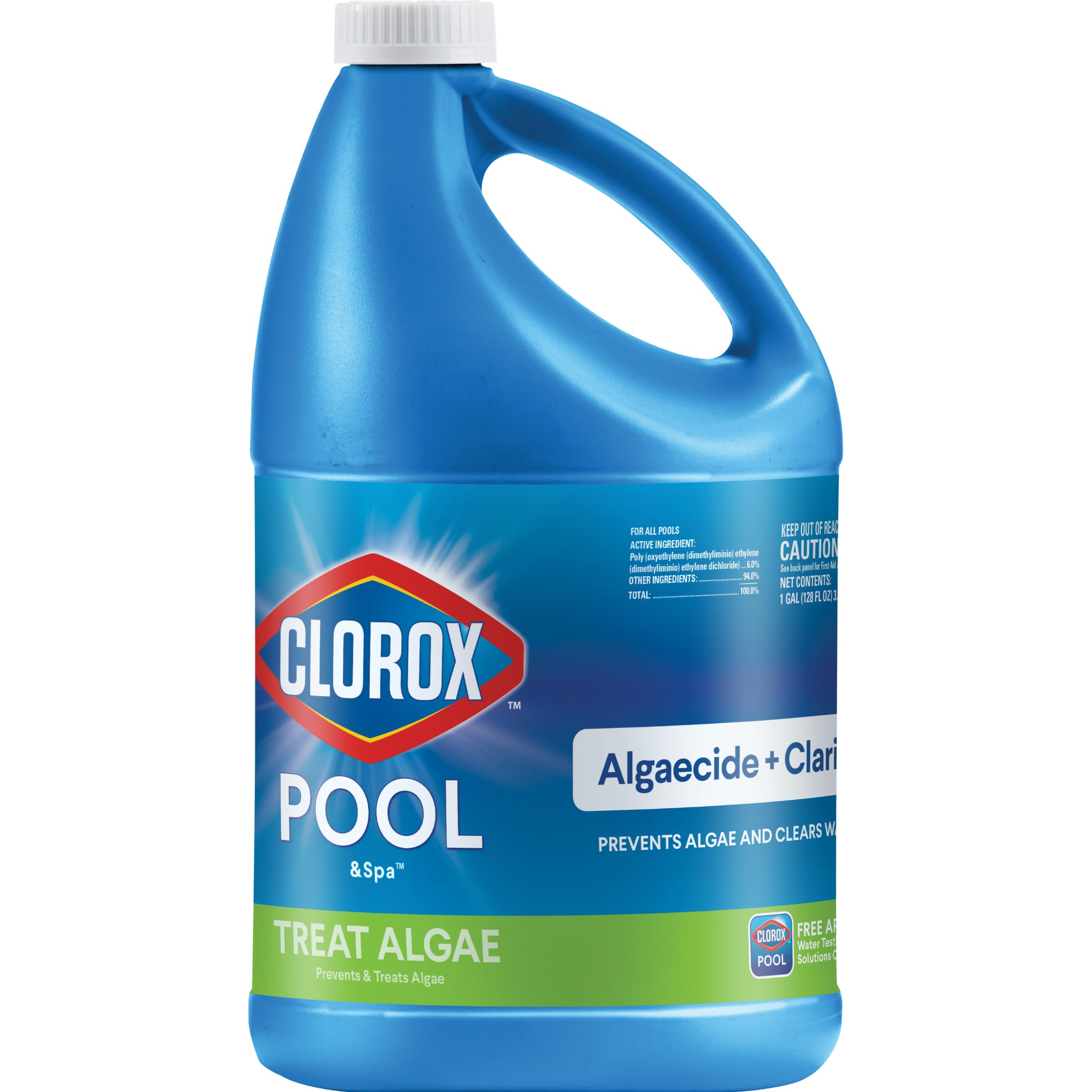
This is the maintenance bottle most pool owners keep on the shelf. The Clorox Algaecide and Clarifier combines an algaecide that kills and prevents green, mustard and black algae with a clarifier that clumps fine particles so the filter can catch them, in a non-foaming gallon that suits every pool type including salt. Poured weekly at the deep end with the filter running, it is the insurance that keeps a balanced pool from turning after a hot weekend or a party, and tens of thousands of owners have reviewed it, giving strong feedback overall. The honest limits: an algaecide is a preventer and a helper, and a pool that is already green needs shock first and this second; the owner rating sits a shade below the plain quart algaecide at rank seven; and a full gallon is awkward to measure from, so keep a marked cup for it.
- Most-reviewed product on this page by a wide margin
- Two jobs in one bottle: algae prevention plus water clarifier
- Gallon size lasts a season of weekly maintenance doses
- Non-foaming, safe for salt pools
- Slightly lower owner rating than the plain Clorox algaecide
- Treating an established bloom still needs shock as well
- Gallon jug is heavy to pour accurately
Clorox Pool&Spa Swimming Pool Algaecide, Prevents and Treats Pool Algae, Non-Foaming, 1 Quart (Pack of 1)

If you want the best-liked algaecide rather than the biggest, this quart of Clorox Pool&Spa Algaecide has the strongest owner rating in the group, with thousands of reviews. It is a concentrated non-foaming formula that kills existing green algae quickly and controls regrowth, suits every pool type including salt, and comes in a size that fits a shelf and pours accurately. The Clorox Pool App supplies a dose from a test reading. It is a single-purpose product: there is no clarifier in it, so a pool that is clear of algae but hazy will need a separate clarifier or a filter clean, and the label focuses on green algae, the common kind; stubborn mustard or black algae call for a shock-heavy attack with brushing and then this to hold the line. A quart will not see a large pool through a whole season of weekly doses, which is where the gallon at rank six earns its place.
- Highest owner rating of the algaecides here
- Concentrated quart is easy to store and pour
- Fast-acting on green algae and keeps it from returning
- Non-foaming, so it will not froth at return jets or in spas
- Quart size needs re-buying sooner than the gallon
- No clarifier, so cloudy water needs a separate product
- Labeled mainly for green algae; mustard and black need a stronger approach
PoolRx Pool Unit #101001 6 Month Algaecide Blue Treats 7.5k-20k gallons, Single

The PoolRx is the opposite approach to a weekly bottle: a cartridge of copper-based minerals that sits in the skimmer or pump basket, releases slowly for up to six months, and holds algae at bay while reducing how much chlorine the pool consumes. Thousands of owners rate it strongly, and the recurring theme is that it let them keep a clear pool with less chlorine and less fuss through the heat of summer. It is rated for 7,500 to 20,000 gallons, so a large pool needs two units, it works in salt pools, and it costs more upfront than any bottle here, which the lower ongoing chemical use is meant to repay. Two cautions from the chemistry: it is an algaecide and demand reducer, not a sanitizer, so you still need chlorine and still need pH, alkalinity and stabilizer in range; and copper minerals can stain plaster if the pH is allowed to run high, which is one more reason to keep the pH Down at rank one handy.
- One unit in the skimmer works for up to six months
- Lets many owners run lower chlorine, cutting weekly chemical cost
- Eliminates all algae types per the maker
- Nothing to measure or pour
- Highest upfront cost on the page
- Sized for 7.5k to 20k gallons; bigger pools need a second unit
- Does not replace chlorine or balancing; it reduces demand, not the need
Compare the picks
| Product | Job | Active ingredient | Size | Salt pool | Our score | Our score | |
|---|---|---|---|---|---|---|---|
| Clorox Pool&Spa pH DownCLOROX Pool&Spa | Lowers pH | Sodium bisulfate, granules | 5 lb | Yes | 9.4/10 | 9.4 | See price |
| Pool Mate pH UpPool Mate | Raises pH | Sodium carbonate | 10 lb | Yes | 9.4/10 | 9.4 | See price |
| Pool Mate Alkalinity IncreaserPool Mate | Raises total alkalinity | Sodium bicarbonate | 10 lb | Yes | 9.4/10 | 9.4 | See price |
| Pool Mate StabilizerPool Mate | Protects chlorine from sun | Cyanuric acid | 7 lb | Yes | 9.2/10 | 9.2 | See price |
| HTH Pool Care StabilizerHTH | Protects chlorine from sun | Cyanuric acid | 4 lb | Yes | 9.4/10 | 9.4 | See price |
| Clorox Algaecide and ClarifierCLOROX Pool&Spa | Prevents algae, clears water | Algaecide plus clarifier | 128 fl oz | Yes | 9.0/10 | 9.0 | See price |
| Clorox Algaecide, quartCLOROX Pool&Spa | Prevents and treats green algae | Concentrated algaecide | 32 fl oz | Yes | 9.2/10 | 9.2 | See price |
| PoolRx 6 Month Unitpoolrx | Algaecide, reduces chlorine demand | Mineral cartridge | 7.5k to 20k gal | Yes | 9.0/10 | 9.0 | See price |
The order of operations
Balancing goes wrong when people chase pH first. Test, then fix total alkalinity with the Pool Mate Alkalinity Increaser until it sits between 80 and 120 ppm, because alkalinity is the buffer that holds pH steady and every pH correction you make before that will wander off again. Next set pH between 7.2 and 7.6 with Clorox pH Down or Pool Mate pH Up, in small doses with the pump running and an hour between tests. Then check stabilizer: a freshly filled pool needs cyanuric acid brought up to the range you have chosen with the Pool Mate or HTH stabilizer, and a pool on stabilized tablets usually needs none added. Only then dose chlorine to its target, which depends on the stabilizer level, and run the weekly algaecide. Doing it in this order means fewer products, fewer retests and a pool that stays where you left it.
Granules, liquids and units
Every balancer on this page is a dry granule, which is deliberate. Dry pH reducer is far safer around children and garages than muriatic acid, sodium carbonate and bicarbonate keep for years in a sealed tub, and granular cyanuric acid is easier to dose than the liquid version even though it dissolves slowly. The algaecides are liquids because that is how a weekly maintenance dose pours and disperses best; add them at the deep end with the filter running so they spread. The PoolRx is the odd one out, a mineral cartridge that lives in the skimmer for months, and it suits owners who would rather pay once than remember a Sunday routine. Whatever you choose, store chemicals apart from each other, never mix them in one bucket, and add chemicals to water rather than water to chemicals.
Saltwater pools and spas
Every product here is labeled for salt pools, and salt owners will use the pH Down more than anyone, because a salt chlorine generator pushes pH upward continuously. Salt pools also lose chlorine to the sun like any other, so stabilizer matters just as much; check your generator’s manual for its preferred cyanuric acid range before choosing between the HTH and Pool Mate targets. For spas and hot tubs the small sizes make more sense, and the non-foaming algaecides are the right kind, since foaming formulas turn a jetted spa into a bubble bath. A copper mineral unit such as the PoolRx should be matched to the water volume on its label; in a small spa it can over-concentrate.
What pool chemicals do I actually need?
A sanitizer, usually chlorine tablets or liquid, plus a pH reducer, a pH increaser, an alkalinity increaser and a cyanuric acid stabilizer, with an algaecide as weekly insurance. The eight products here cover everything except the sanitizer, which our chlorine tablets and shock guide covers.
Should I fix pH or alkalinity first?
Alkalinity first. It buffers pH, so a pool with low alkalinity will not hold any pH you set. Bring total alkalinity to 80 to 120 ppm with the Pool Mate Alkalinity Increaser, then adjust pH to 7.2 to 7.6 with pH Down or pH Up, retesting an hour after each dose.
Can I use baking soda and soda ash from the grocery store?
Chemically they are the same as the Pool Mate alkalinity increaser and pH Up, and many owners do. The pool versions come in larger tubs with a pool-specific dosing chart, which is the main thing you are paying for.
How much stabilizer is too much?
Cyanuric acid never leaves the water on its own, so it only goes up. Above roughly 100 ppm it starts to lock up chlorine and the pool can turn green with a chlorine reading that looks fine; the only fix is draining and refilling part of the pool. If you use stabilized trichlor tablets you add stabilizer every week already, so test before adding more.
Does algaecide replace shock?
No. Algaecide prevents algae and helps kill a light bloom; an established green pool needs shock to kill it, brushing to break it up, filtration to remove it, and then a weekly algaecide such as the Clorox products to stop it returning. The PoolRx reduces chlorine demand but still needs chlorine in the water.
Prices and stock change daily. The buttons above open Amazon so you always see the current price. We may earn a commission if you buy through them, at no extra cost to you.
Do Best Deal is a participant in the Amazon Services LLC Associates Program. As an Amazon Associate we earn from qualifying purchases. If you buy through links on this site we may earn a commission, at no extra cost to you. Learn more.


