The graphics card draws the frames, but the processor decides how many it is allowed to draw: in most games at 1080p and 1440p it is the CPU that feeds the GPU, handles the physics and the AI, and sets the floor for how smooth the worst moments feel. The good news is that gaming does not need the most cores; it needs fast cores, a lot of cache close to them, and a platform that will accept a better chip in three years. We ranked the processors and processor bundles in our PC parts catalog by core and thread count, boost clock, cache (including AMD’s stacked 3D V-Cache), socket and memory platform, whether a cooler or graphics is included, and what thousands of builders report after months of use.
We have not benchmarked every one of these ourselves; the verdicts rest on the manufacturer spec sheets and on the owner review history. Prices are not printed because they change daily; every button opens the live Amazon page. Pair your pick with a board from our gaming motherboards guide, memory from the RAM kits for gaming PCs guide and a card from the budget graphics cards guide.
How we picked
- Gaming first. Boost clock and cache are weighted over core count; a 6-core chip at 5.4 GHz beats a slow 16-core for frames.
- Platform life. AM5 and Intel 800-series picks take future chips; the AM4 and LGA 1700 picks are flagged as end-of-line upgrades.
- Owner feedback that is strong and consistent across hundreds to thousands of builder reviews.
- What is in the box. None of the bare CPUs here includes a cooler; the two combos include a motherboard. We say so each time.
- A spread of budgets, from a mid-range six-core to a 16-core flagship, plus two bundles for first builds.
The picks
AMD Ryzen™ 5 9600X 6-Core, 12-Thread Unlocked Desktop Processor

The Ryzen 5 9600X is the gaming processor most people should buy and, by owner rating, the most-liked part in our PC catalog. Six Zen 5 cores and twelve threads boost to 5.4 GHz, backed by 38 MB of cache and DDR5-5600 support, which AMD positions for smooth 100-plus frames per second in the games people actually play; in practice a graphics card below the top tier will run out of headroom before this chip does. It is unlocked for overclocking and sits on the AM5 socket, the platform AMD has committed to for years, with PCIe 5.0 available on the right motherboard. Thousands of builders give it an excellent rating, with praise for temperatures and ease of setup. There is no cooler in the box, and six cores is a gaming choice rather than a workstation one; for streaming and rendering on the same PC, step up to the 9950X3D.
- Best owner rating in our PC parts catalog, from thousands of builders
- Zen 5 cores at 5.4 GHz handle 100-plus FPS in popular games
- AM5 socket has years of upgrades ahead
- Unlocked, with PCIe 5.0 on the right board
- No cooler in the box
- Six cores is enough for gaming but not for heavy streaming plus rendering
- Needs DDR5 memory and an AM5 board, so an AM4 owner starts over

The Ryzen 9 9950X3D is what you buy when you refuse to choose between a gaming chip and a workstation chip. Sixteen Zen 5 cores boost to 5.7 GHz, and AMD stacks its second-generation 3D V-Cache on top, the extra slab of cache that gives the X3D chips their reputation for high and steady frame rates in cache-hungry games. The result is a processor that renders video and compiles code at the pace of a 16-core and games like a dedicated X3D part. It sits on AM5, so a 9600X owner can swap it in without changing the board. Thousands of owners rate it strongly. It costs several times the 9600X, it wants a high-end cooler and a board with robust power delivery, and with a mid-range graphics card almost none of its advantage shows on screen. It is the right chip for a flagship GPU and a creator workload.
- 16 cores plus stacked 3D V-Cache: gaming and content creation in one chip
- 5.7 GHz boost, the highest here
- Thousands of owner reviews with a strong owner rating
- Same AM5 socket as the 9600X, so the board carries over
- Costs several times the 9600X
- Needs a serious cooler and a board with strong power delivery
- Overkill for a mid-range graphics card
Intel® Core™ Ultra 9 Processor 285K 24 cores (8 P-cores + 16 E-cores) up to 5.7 GHz
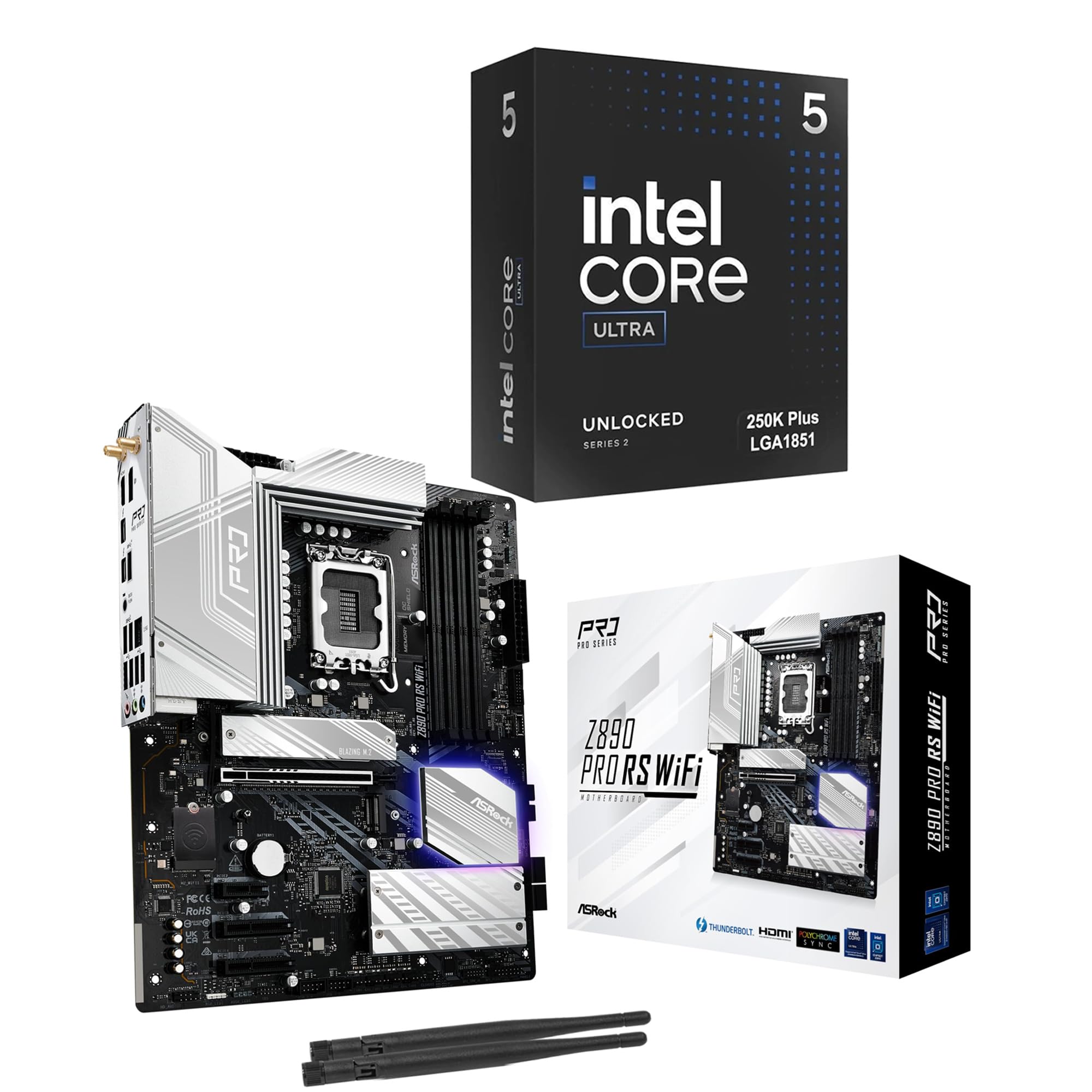
The Core Ultra 9 285K is the Intel chip for a top-end gaming build. Its 24 cores split into eight Performance cores that take the game and sixteen Efficient cores that absorb Discord, the browser and the stream encoder, all boosting to 5.7 GHz with 40 MB of cache, and Intel says the Core Ultra design runs cooler and quieter than the generation before. It includes integrated graphics, useful for a build that has not received its card yet, and the 800-series platform brings DDR5 and PCIe 5.0. Thousands of owners rate it strongly. It ships without a cooler, its 125-watt base power wants a good one, and it needs a new 800-series motherboard, so there is no cheap upgrade from an older Intel board. Against the 9950X3D at a similar price it trades 3D cache for more efficient cores and integrated graphics; for pure gaming AMD edges it, for a mixed desktop it is a fine choice.
- Hybrid architecture sends games to the P-cores and background tasks to the E-cores
- Integrated graphics means it boots without a card for troubleshooting
- Thousands of owner reviews with a strong owner rating
- PCIe 5.0 and DDR5 on the 800 series platform
- No cooler in the box and a 125W base power
- Needs an 800 series board, so no upgrade path from LGA 1700
- Priced close to the 9950X3D without its 3D cache
AMD Ryzen 7 5800X3D 8-core, 16-Thread Desktop Processor with AMD 3D V-Cache Technology
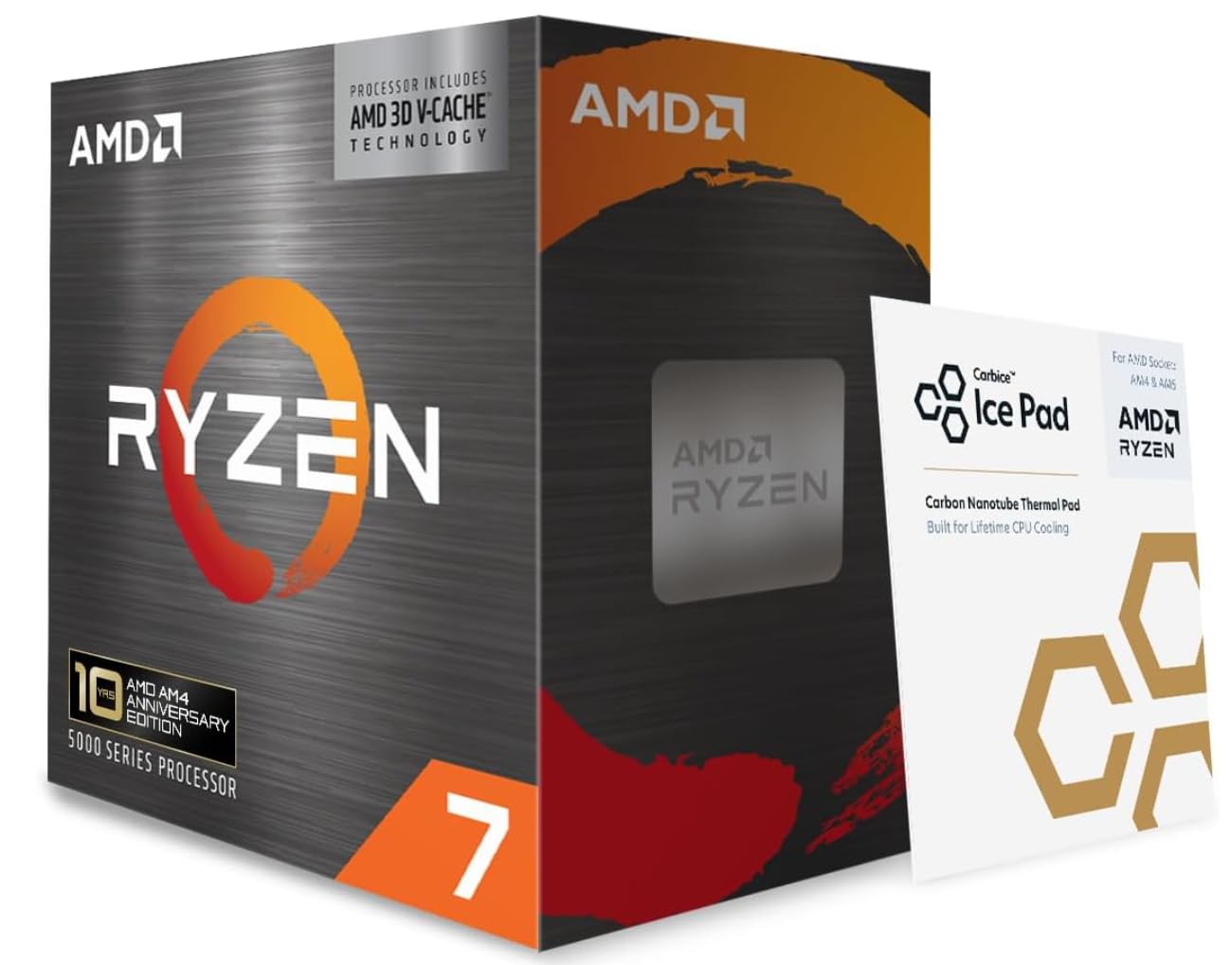
The Ryzen 7 5800X3D is the processor that lets an AM4 owner skip a whole rebuild. It drops into an X570 or B550 board after a BIOS update, keeps the DDR4-3200 memory already in the machine, and brings the first generation of AMD’s 3D V-Cache: 96 MB of L3 cache that lifts frame rates in open-world and simulation games far beyond what its 4.5 GHz boost suggests. Eight cores and sixteen threads handle a game and a stream together. Thousands of owners rate it strongly, and the common story in the reviews is a five-year-old PC that suddenly matches a new one. It is the end of the AM4 road, so there is nothing to upgrade to afterward, it cannot be overclocked, and new-build buyers should ignore it in favour of the 9600X on AM5. For anyone with an AM4 board and a decent graphics card, it is the best money they can spend.
- Drops into an existing AM4 board with a BIOS update, keeping DDR4 memory
- Huge 3D V-Cache keeps frame rates high in cache-heavy games
- Thousands of owner reviews with a strong owner rating
- Eight cores is plenty for gaming plus a stream
- End of the AM4 line; there is no next chip for this socket
- Not overclockable, and a modest 4.5 GHz boost
- Often priced above the newer 9600X
AMD Ryzen 5 7600X + GIGABYTE B650 AORUS ELITE AX Motherboard
The Ryzen 5 7600X and Gigabyte B650 Aorus Elite AX bundle is the sensible starting point for a first AM5 build. The 7600X gives six Zen 4 cores at up to 5.3 GHz with 38 MB of cache and DDR5-5200 support, which AMD still rates for 100-plus frames per second in the big multiplayer titles, and the Aorus Elite AX is more board than a six-core needs: twin 14+2+1 power phases with 70-amp stages on an eight-layer PCB, four DDR5 slots with EXPO and XMP profiles, and built-in Wi-Fi. That headroom means a Ryzen 9 can go in later without touching the board. Thousands of owners rate the pair strongly. The 7600X is one generation behind the 9600X, it ships without a cooler and is known to run warm, and the bundle is not always cheaper than the two parts bought apart, so check both prices before you click.
- CPU and a well-built AM5 board in one box
- Thousands of owner reviews with a strong owner rating
- 70A power stages leave room for a future Ryzen 9
- Zen 4 six-core still hits 100-plus FPS in popular games
- 7600X is a generation behind the 9600X
- No cooler, and the 7600X runs warm
- Bundle pricing is not always cheaper than buying separately
Micro Center CPU Motherboard 12600KF 12th Gen 10-Cores LGA 1700 Desktop Processor with MSI PRO B760-P WiFi DDR4 ProSeries Motherboard
The Micro Center bundle pairs the Core i5-12600KF with an MSI PRO B760-P WiFi DDR4 board, and it exists for one buyer: the person with good DDR4 memory and a graphics card who wants ten cores without paying for DDR5. The 12600KF turbos to 4.9 GHz with 20 MB of Smart Cache and the hybrid layout that puts games on fast cores and the rest on efficient ones; the board adds four DDR4 slots to 128 GB, two PCIe 4.0 M.2 slots, 2.5-gigabit LAN and Wi-Fi 6E on a six-layer board with a 12+1 power design. Hundreds of owners rate it strongly. The limits are generational: 12th-gen Intel on LGA 1700 has little upgrade future, the KF suffix means no integrated graphics so a card is compulsory, and there is no cooler. As a cheap, competent 1080p and 1440p gaming platform built from parts you may already own, it is still a good deal.
- Reuses DDR4 memory, the cheapest way into a 10-core gaming PC
- Board has two PCIe 4.0 M.2 slots, 2.5G LAN and Wi-Fi 6E
- Hundreds of owner reviews with a strong owner rating
- Hyper-threading P-cores plus E-cores for background tasks
- 12th generation chip and LGA 1700 is a dead-end socket
- KF has no integrated graphics; a card is mandatory
- No cooler in the bundle
Compare the picks
| Product | Cores / threads | Boost | Cache | Platform | Our score | Our score | |
|---|---|---|---|---|---|---|---|
| Ryzen 5 9600XAMD | 6 / 12, Zen 5 | 5.4 GHz | 38 MB | AM5, DDR5-5600 | 9.8/10 | 9.8 | See price |
| Ryzen 9 9950X3DAMD | 16 cores, Zen 5 | 5.7 GHz | 2nd gen 3D V-Cache | AM5 | 9.4/10 | 9.4 | See price |
| Core Ultra 9 285KIntel | 24 / 24, 8P + 16E | 5.7 GHz | 40 MB | Intel 800 series, DDR5 | 9.2/10 | 9.2 | See price |
| Ryzen 7 5800X3DAMD | 8 / 16 | 4.5 GHz | 96 MB L3, 3D V-Cache | AM4, DDR4-3200 | 9.2/10 | 9.2 | See price |
| Ryzen 5 7600X + B650 Aorus Elite AXAMD | 6 / 12, Zen 4 | 5.3 GHz | 38 MB | AM5 board included, DDR5 | 9.0/10 | 9.0 | See price |
| Core i5-12600KF + MSI B760-P DDR4Micro Center | 10 cores | 4.9 GHz | 20 MB | LGA 1700 board included, DDR4 | 8.8/10 | 8.8 | See price |
How many cores does gaming need?
Six fast cores. Games spread work across a handful of threads and then wait on the fastest one, which is why the six-core Ryzen 5 9600X at 5.4 GHz matches or beats slower chips with twice the cores in most titles. Eight cores (5800X3D) give room for a stream encoder or a Discord call without dropping frames. Sixteen or twenty-four (9950X3D, 285K) are for people who also render, compile or edit video on the same machine; in a game alone they are rarely faster than the six-core, and with a mid-range graphics card they are not faster at all. Spend the difference on the graphics card, memory or a better monitor.
Why 3D V-Cache matters
AMD’s X3D chips stack an extra slab of L3 cache on the processor die, so the data a game keeps asking for is already next to the cores instead of out in system memory. The effect is biggest in simulation, strategy and open-world games and in the stutters that happen when a lot of objects load at once: the 5800X3D’s 96 MB of L3 lets a 4.5 GHz chip keep pace with newer, faster-clocked parts, and the 9950X3D’s second-generation stack does the same on top of Zen 5 clocks. The trade-offs are heat, price and, on the 5800X3D, no overclocking. For a budget build the plain 9600X is the better value; for the smoothest frame times money can buy, an X3D.
AM5, AM4 or Intel: choosing a platform
AM5 (9600X, 9950X3D, 7600X combo) is the platform to build on today: DDR5, PCIe 5.0 on the right board, and AMD’s commitment to keep releasing chips for the socket, so the board you buy now takes a better processor later. AM4 (5800X3D) is finished but enormous: millions of X570 and B550 boards can take the 5800X3D as a final upgrade with the DDR4 already installed. Intel’s 800 series (285K) brings DDR5 and PCIe 5.0 with integrated graphics on the chip; LGA 1700 (12600KF combo) is the previous Intel socket and the cheap DDR4 route. Whatever you choose, remember that none of these processors includes a cooler, so budget for one that matches the chip’s power rating.
Is AMD or Intel better for gaming right now?
For most builds AMD: the Ryzen 5 9600X offers the best value and the X3D chips the highest frame rates, all on the long-lived AM5 socket. The Intel Core Ultra 9 285K is the pick for a top-end Intel build or anyone who wants integrated graphics and strong multi-core performance alongside gaming.
Do I need a 3D V-Cache (X3D) CPU for gaming?
No, but it helps in cache-heavy games and for smooth frame times. The 9600X without 3D cache is excellent for the money. Buy an X3D chip such as the 9950X3D or 5800X3D if you run a flagship graphics card or play simulation and open-world games where the cache shows.
Which CPU should I buy to upgrade an old AM4 PC?
The Ryzen 7 5800X3D. It drops into X570 and B550 boards after a BIOS update, keeps your DDR4 memory, and its 96 MB of L3 cache brings gaming performance close to current chips. It is the last stop on AM4, so a future upgrade means a new board.
Does a gaming CPU come with a cooler?
None of the six picks here includes one. The 9600X and 7600X run fine on a good tower air cooler; the 9950X3D, 285K and 5800X3D want a large tower or a liquid cooler. Check the socket on the cooler box matches AM5, AM4 or LGA 1700 and 1851.
Is a CPU and motherboard combo worth it?
It saves the compatibility homework and sometimes money. The Ryzen 5 7600X with the B650 Aorus Elite AX is a strong AM5 start with room for a Ryzen 9 later; the 12600KF with the MSI B760-P DDR4 is the cheapest way to reuse DDR4 memory. Always compare the bundle price with the two parts bought separately.
Prices and stock change daily. The buttons above open Amazon so you always see the current price. We may earn a commission if you buy through them, at no extra cost to you.
Do Best Deal is a participant in the Amazon Services LLC Associates Program. As an Amazon Associate we earn from qualifying purchases. If you buy through links on this site we may earn a commission, at no extra cost to you. Learn more.
